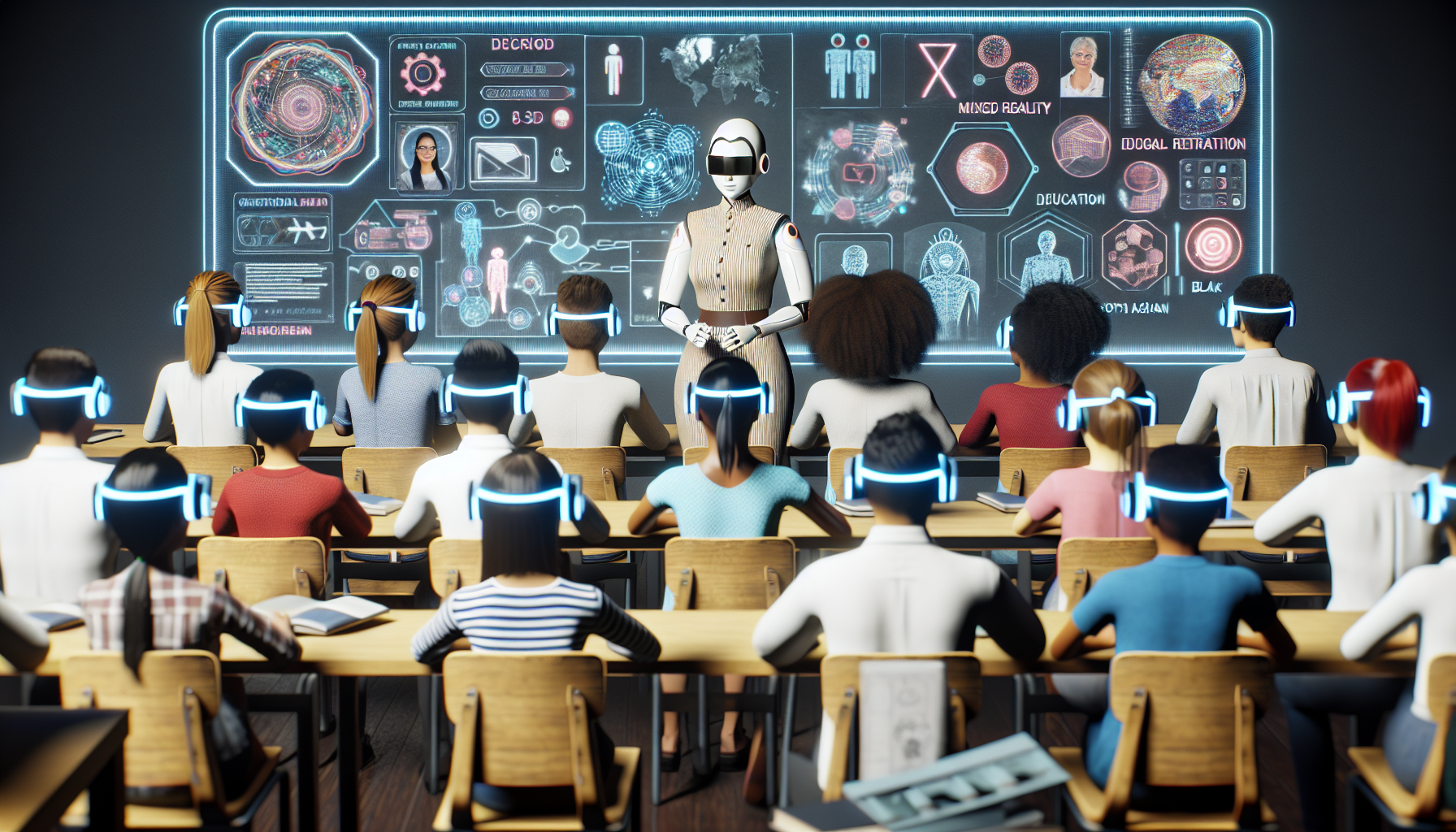
Technological Innovations for Future Education: AI Teachers and Mixed Reality Learning
AI teachers can also assist in administrative tasks, reducing the workload on human educators and allowing them to focus more on interactive and creative teaching methods. This technology is particularly beneficial in large classrooms where individual attention is challenging to provide. By leveraging AI, educators can ensure that no student is left behind, as the system continuously monitors and adjusts to each learner’s pace and style.
Mixed Reality: Bridging the Gap **Mixed Reality (MR)** is another groundbreaking innovation reshaping the educational landscape. By combining elements of both virtual reality (VR) and augmented reality (AR), MR creates immersive learning environments that enhance student engagement and understanding. This technology allows students to interact with 3D models, conduct virtual experiments, and explore complex concepts in a more tangible and intuitive manner.For instance, in a biology class, students can explore the human body in 3D, examining organs and systems in detail without the need for physical specimens. In history lessons, learners can virtually visit ancient civilizations, experiencing the culture and architecture firsthand. This hands-on approach not only makes learning more enjoyable but also aids in the retention of information by providing real-world context.
Another consideration is the **training of educators** to effectively integrate these technologies into their teaching practices. Professional development programs are essential to equip teachers with the necessary skills to utilize AI and MR tools effectively. Additionally, there are concerns about data privacy and the ethical use of AI in monitoring student performance. Establishing clear guidelines and policies is vital to protect student information and ensure ethical practices.
The Future of Education As we look to the future, the role of technology in education will continue to expand. The integration of AI and MR offers exciting possibilities for creating more inclusive, engaging, and effective learning environments. These innovations have the potential to democratize education, providing personalized learning experiences to students regardless of their location or background.However, the successful implementation of these technologies requires collaboration between educators, policymakers, and technology developers. By working together, we can overcome the challenges and harness the full potential of AI and MR to transform education for future generations.